




Housing strategy may boost renovation jobs
November 28, 2017
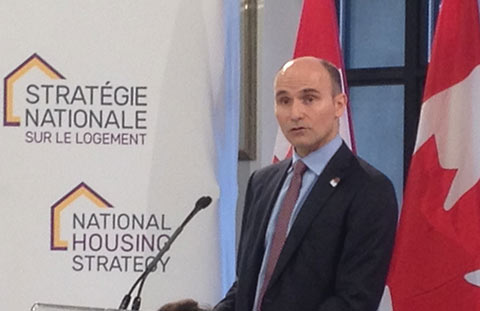
Jean-Yves Duclos, Minister of Families, Children and Social Development and minister responsible for Canada Mortgage and Housing Corp., outlined the National Housing Strategy in Vancouver. - Home BUILDER
The federal government’s new 10-year, $40 billion National Housing Strategy will eventually lead to more construction jobs in the renovation and home building industry, but details and timing remain vague.
The strategy also fails to address key elements of housing affordability, some critics say.
By focusing on rental and social housing, the strategy does little to help the majority of Canadians who own or aspire to a buy a home, according to the Canadian Home Builders Association (CHBA).
“The majority of Canadians are talking about and worried about house prices and how millennials will be able to afford their homes,” said Kevin Lee, CEO of the CHBA, “We definitely would have liked to have seen something more.”
In Vancouver, experts questioned how the government would deliver the thousands of new housing units the strategy calls for.
Developer and architect Michael Geller said the government would have difficulty securing enough land for the thousands of homes they are planning to build. He noted that residential development land in Vancouver is now selling for more than $450 per square foot. Geller, and others, also said a proposed $2,500 annual rental subsidy would be “insignificant” in major cities like Vancouver and Toronto where affordability is the worst.
David Goodman of HQ Commercial in Vancouver said landlords should not fear sudden competition from new government-backed purpose-built rentals. “It will take years before we see any of these units.”
Due to zoning and permit delays and current backlogs, none of the rental apartments under the National Housing Strategy would be ready for at least eight years in Metro Vancouver, he said.
The widest criticism, however, was on the lack of details on the delivery. The strategy does not start until after the 2019 federal election and still requires matching funds from other levels of government.
Yet the job creation potential of the plan is promising. If and when it gets rolling, the strategy calls for the construction of 72,000 homes over the next 10 years. It would also pay for the renovation of 300,000 existing homes, mostly subsidized rental units.
Jean-Yves Duclos, Minister of Families, Children and Social Development and minister responsible for Canada Mortgage and Housing Corp., outlined the National Housing Strategy in Vancouver.
Duclos emphasized it will take a co-operative approach and joint funding from provincial and territorial governments to deliver the program.
The Strategy highlights include:
• $15.9 billion for a new National Housing Co-Investment Fund
• $8.6 billion for a new Canada Community Housing Initiative in partnership with provinces and territories, and $500 million through a new Federal Community Housing Initiative
• $4 billion for a new Canada Housing Benefit to be launched in 2020 in partnership with provinces and territories; this would provide about a $200 monthly rental subsidy for about 385,000 tenants
• $2.2 billion to reduce homelessness
• $300 million in additional federal funding to address housing needs in Canada’s North
• $241 million for research, data and demonstrations