




Foam insulation may mitigate flood damage
October 4, 2017
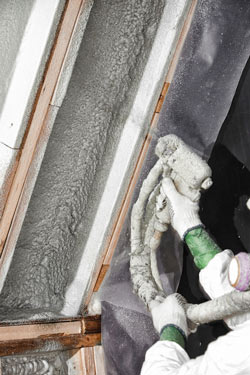 |
Icynene foam insulation could mitigate flood damage in houses, according to Paul Duffy, chair of the Spray Foam Coalition (SFC) and chair of the SFC Research Committee for the American Chemistry Council. Duffy is also a vice-president at Icynene.
“Both open-cell and closed-cell spray foam insulation can be used throughout a residential or commercial structure to manage and minimize moisture ingress,” Duffy said in a statement to Home BUILDER magazine.
“When it comes to addressing moisture, open-cell foam is better suited for use against building materials that can be damaged by water build-up. When applied against these types of materials (for example, exterior wood sheathing), insulation should allow moisture diffusion to occur, just enough to let adjacent building materials breathe in order to prevent moisture entrapment. Open-cell foam delivers this ‘breathability’ and allows building materials to dry, minimizing moisture build-up and related problems such as mould,” he wrote.
Duffy said that when the foam is applied to the underside of a roof deck, in the event of a roof leak, “water drains straight through the insulation by gravity rather than being trapped against the roof sheathing where it could contribute to roof rot.”
Upon drying, some open-cell spray foam insulation products return to their original state without warping or distortion, and the effectiveness of the insulation is restored back to its original performance potential.”
Duffy added that the U.S. Federal Emergency Management Agency (FEMA) has identified closed-cell spray foam as a flood resistant material capable of withstanding direct and prolonged contact with floodwaters without sustaining significant damage.
Home BUILDER magazine will take a closer look at foam insulation as a water resistant material in an upcoming print edition.