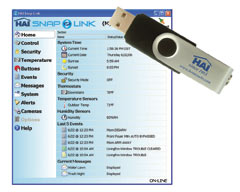
Every builder tries to put a little heart into their construction work, but what about a brain? With the push of a button, a computerized automation system can take a lot of the thinking - and work - out of a homeowner's everyday routine. Lights turn themselves off when a room isn't occupied or go on dimmed when walking to the bathroom in the middle of the night, and climate control reduces heat or cooling consumption when nobody is home, to name just a few of the innumerable features possible in a "smart home."
"Builders need to look at what differentiates their homes from a competitors'," says ROBERT MOWLES, president and owner of Aartech (www.aartech.ca), a home automation system distributor based in Toronto. "Home automation offers a greater level of functionality and personalization, since it can be tailored to the end-user's needs and budget."
Home automation, also called domotics, uses computerized, centrally controlled devices to increase a home's comfort, convenience and security. "An important added benefit is that systems can be programmed to reduce energy use, particularly during peak hours, so electricity expense are reduced. For many clients, part of the attraction is the 'cool factor' - the high-tech features that will impress guests," says Mowles.
Depending on the standard used - X10, INSTEON, ZigBee and Z-Wave, among others - a domotics system may employ devices that use either embedded signals in the power line or radio frequency signals (the easiest to retrofit into an existing house), specialized communication and control wiring (the hardest to retrofit), or a combination of several methods. While specialized wiring, especially if installed while a house is being built, offers the best results, it is also the most expensive option. A much cheaper alternative, says Mowles, is employing a structured wiring set-up, where phone, video and computer networking cables are run in bundles from combined outlet points throughout a house to a central location - much preferable to "daisy-chained" wiring, where cables are run in a series from one outlet or jack to the next. "With structured wiring, you're essentially 'future-proofing' a home. Even if a client doesn't want a domotics system now, installing one later will be much simpler and cheaper," he says.
According to BRUCE MILLER, owner and president of TriVista Smart Homes, a distributor and contractor with offices in Ottawa and Toronto, the main obstacles to wider adoption of domotics in Canada are lack of consumer knowledge and disposable income. "Few people in Canada are aware of home automation. It has not become mainstream, and I'd say the per capita market uptake here is about 30 to 50 per cent of what you'd find in the U.S. Our high-end luxury home market is smaller, and that's where trends like this tend to take root."
Owners of homes in the million-dollar-plus range, with large budgets and expensive home theatres, spend the most on domotics systems: $100,000 and up, with the average being $150,000. However, in terms of market share, Miller says his main customers are median-income families building or buying a home in the $300,000-and-up range, with a typical sale of $5,000 to $100,000, though the average is about $15,000. "Everyone has their own preferences for what a system should do, from practical things like monitoring carbon monoxide, flooding or fire, to little pleasures like being able to play music and control volume levels in any room of your house," says Miller, adding that "the safety, convenience, entertainment, and efficiency possibilities are limited only by your imagination."
homeBUILDERcanada.com | Home BUILDER Magazine | Canada's #1 Information Source for Residential Home Builders and Professional Renovators