



An "Orderly Slowdown"
in Quebec
 |
By Ann-Margret Hovsepian
While housing affordability
declines across the country, Quebec's price growth has tapered to a single-digit
rate compared to the gains seen two or three years ago. "Most of Quebec's
housing markets are in the midst of an orderly slowdown," says Derek
Holt, assistant chief economist at the RBC Royal Bank, adding that the province's
condominium market is the exception to the deterioration in affordability
among the four housing segments. The other three - detached bungalows, townhomes
and two-storey homes - saw mild price gains in the range of four to six per
cent, mainly because of slow income growth, higher mortgage rates, property
taxes and rising utilities costs.
At RE/MAX Quebec, executive vice-president Sylvain Dansereau says the 2007
year-end projection for average price in Montreal is an estimated $224,600,
with sales matching 2006's record of close to 50,000 units.
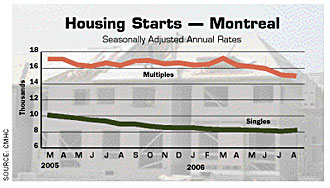
Residential starts are also declining in Quebec, and builders report that
they expect this slowdown to continue. According to the CHBA's June/July 2006
Pulse Survey, new home builders expected total starts to reach 45,000 units,
down from the 50,910 units started in 2005. Starts are expected to decline
further in 2007, to about 40,000 units.
In September, 2,927 housing units were started in the province's urban centres
- a decrease of 23 per cent from the same month last year. For 2006, Quebec
has seen 27,486 starts in urban centres, a drop of 9 per cent from the first
nine months of 2005. "[These numbers] are perfectly in line with the
forecasts that we published a year ago," says Kevin Hughes, senior economist
at Canada Mortgage and Housing Corporation. "I anticipate that new starts
will maintain this pace for the rest of the year."
A 20 per cent drop in single-detached starts in September (1,185 units compared
to 1,477 the year before) reflects a significant decrease in activity in major
cities such as Montreal (down 33 per cent), Québec (16 per cent) and
Sherbrooke (36 per cent). Smaller cities (50,000 to 99,999 inhabitants) posted
a gain over the same month last year while rural areas had mixed results.
Rental housing also saw a decline in starts. In the second quarter of 2006,
there was a 21 per cent drop in starts compared to the same period last year,
and retirement homes accounted for a significant share of the 2,562 units
started.
In CHMC's third-quarter Housing Now report on Quebec, the decline in starts
is attributed to "moderate migration and economic growth, as well as
a greater availability of existing homes for sale, for which the growth in
prices has considerably slowed down." The resale market in Quebec continues
to resist the declines seen in the construction sector. A growth in personal
disposable income and good borrowing conditions contributed to a 2.4 increase
in MLS transactions (35,341) during the first five months of the year, compared
to 2005. According to the Canadian Real Estate Association, the average price
recorded on the MLS rose by seven per cent over the first five months, reaching
$192,407, a slight slowdown from the price increases seen in 2005 and 2004.
CMHC anticipates that slower sales, price growth and rising listings are bringing
the province's resale market toward a more balanced state and, as a result,
fewer buyers will turn to the new home market. The CHBA Pulse Survey reported
that new home builders in Quebec plan "some shift in the upcoming year
toward targeting move-down buyers and the custom segment of the move-up market,
away from first-time buyers."
On a brighter note, about one-third of Quebec renovators reported increased
activity over the past 12 months, while only one in six reported lower activity,
and this increase in renovations is expected to continue. HB