




A Sound Investment:
Structured Wiring offers Future Flexibility
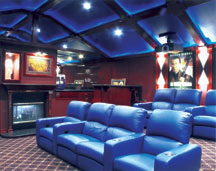 |
By Judy Penz Sheluk
According to Statistics
Canada, consumer spending on televisions and home theatre systems increased
by more than 10 percent in 2005, the strongest annual increase among all major
expenditure categories. So it stands to reason that members of the Appraisal
Institute of Canada cite home theatre rooms as the top trend in home renovation
- above hardwood floors, main floor laundry rooms and updating kitchens and
bathrooms.
Home theatre is also on the wish list of many new homebuyers, and some savvy
builders are starting to offer media rooms as an upgrade. But the upgrade
potential doesn't have to stop there. As homeowners become more immersed in
technology, offering structured wiring packages as a standard or optional
amenity can be an additional revenue source.
Simply defined, structured wiring is a planned cabling approach which systematically
lays out the wiring and wire management necessary for in-home communications
(including voice, data and video) into a single consolidated wiring system.
The sales pitch? By pre-wiring, homeowners will be able to expand their home
automation system with a minimum of fuss.
"It can be both difficult and expensive to wire an entire house after
the walls are up," said John Scott, owner of The Sound Choice in Ottawa,
a member of the Custom Electronic Design & Installation Association (CEDIA),
and a CEDIA Certified Professional. "While most of us can't predict what
technology we will want to install around the house in the next 10 years,
high bandwidth cabling in each room will ease the process."
"By explaining this, new home buyers may elect to pre-wire their home
to handle these requirements - even if they will not be utilizing all of the
cabling right away," said Scott. "This is also true of the homeowner
looking to remodel or build an addition. Pre-wiring for the future just makes
sense."
Installing structured wiring allows for a host of major home automation and
technology integration systems, including: Data Networking (links each PC
in a home directly to the residential gateway of a high-speed Internet connection
or a shared modem); Distributed Audio (makes it possible to install speakers
and controls in every room of a house, while maintaining audio equipment in
one central location); Distributed Video (allows any video source device around
the home to be selected and viewed on any TV); Voice Communications (hassle-free
telephone/intercom installations); HVAC Interface, Home Security and Surveillance,
Lighting Control and Sprinkler System Control.
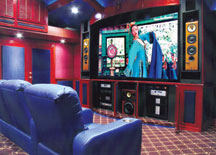
So how do you choose a company that is qualified and trained to install structured
wiring which is geared towards tomorrow's technology? According to Marilyn
Sanford, owner of the Vancouver-based La Scala Home Cinema + Integrated Media,
and a founding member of CEDIA in Canada, the solution lies in viewing low
voltage installers as a 'fourth' trade in the building and remodeling industries,
alongside electrical, plumbing and HVAC professionals.
"There are many professionals who specialize in some of the technologies,
such as security, telephone and cable, electricians, IT technicians and A/V
dealers, however, other than the electronic systems contractor (ESC), no one
trade is currently certified or trained to install all available home electronics,"
said Sanford.
"Even electricians, who are trained to handle electrical current, are
lacking in the depth and knowledge necessary to effectively integrate the
current array of diverse and rapidly evolving technologies."
"As such, builders, contractors and other professionals can only benefit
from hiring a CEDIA-certified ESC to assist with the design, engineering and
installation of structured wiring. Unfortunately, it's a relatively new industry,
and the A/V person is often regarded as noise in their already hectic environment."
"In fact," continued Sanford, "the reverse is true. In a field
that is fast implicating most areas of the home, hiring an electronic systems
contractor can minimize risks, in the same way that hiring a qualified electrician
or plumber minimizes risk."
It also doesn't preclude the builder or contractor from scheduling, coordinating
and keeping a watchful eye on the quality and completeness of work. Just think
of it as pre-wiring your business for the future. HB
Founded in 1989, CEDIA's
3,000 member companies work closely with homebuilders, contractors and homeowners.
1-800-669-5329 www.cedia.org