



Canada
Wonder Windows
By Frank O'Brien
Security, energy savings lead fenestration changes
 |
It was a successful public
relations event that also showed how far window security research has come.
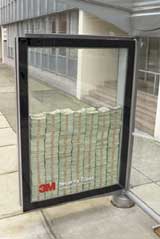
This winter in Vancouver, a stack of bills - if all real, worth $3 million
- were packed behind two panes of glass coated with a new Trim Line security
glazing film developed by 3M Inc. and placed at a bus stop. If you could break
the glass, the money was yours.
The majority of the money was fake. Only $500 worth of $20 bills placed at
the top of the pile was real. But that didn't stop people from kicking and
hitting the display trying to claim the money, all in vain. According to 3M,
the Trim Line film is so tough it will even stop a bullet. And it is not the
only tough security film on the market. Another version, by U.S-based Window
Factory, known as House Armor, can stop a sledgehammer. Other recent examples
are CertainTeed's Bryn Mowr and New Castle vinyl windows with impact-resistant
glass. In tests, the windows withstood the impact of an eight-foot-long 2-by-4
fired into it at 50 feet per second. The durable windows feature an insulated
glass unit with a laminated piece of glass on the interior that contains a
tough layer of polyvinyl butyral (PVB) for increased safety. Upon impact from
debris or wind, the laminated glass may crack, but the pieces adhere to the
PVB interlayer keeping the window unit intact, thus protecting the home's
structural integrity.
Partially with funding from Natural Resources Canada and further fueled by
hurricane research in the southern U.S., North American manufacturers are
developing the hardest windows ever made.
Energy Savings
For most Canadian homeowners, though, the real security needed is protection
against cold and high heating costs. And, since poorly insulated windows can
represent a major heat loss, energy-saving windows have become a major consumer
and industry focus.
Since it was introduced in April of last year, Canada's Energy Star program
for windows has registered 33 window manufacturers whose products meet the
standard for Energy Star labels. The windows and sliding glass doors are qualified
for their energy efficiency by either a U-value or an Energy Rating (ER) for
each of four Canadian zones, ranging from the balmy west coast (A) to the
frigid arctic (D).
The U-value indicates the rate of heat transfer in watts per square metre.
The lower the U-value number, the slower it transfers heat from a warm area
to a cold area.
An R-value is the inverse of a U-value and indicates the resistance to heat
transfer. The higher the R-value number, the more insulative the product is.
The R-values given are in Imperial units. Neither the U or R value account
for heat energy from the sun (solar gain).
The resulting ER value is calculated using a formula that balances a product's
U-value with its potential solar gain and air-tightness. Most sliding glass
doors and openable windows will have a negative ER number. This means that,
averaged over the heating season, the product loses more heat energy than
it gains. The higher the negative ER number, the more heat energy it loses
so a product with an ER of -25 is less energy efficient than a product with
an ER of -5. A positive number means that the product can gain more heat energy
than it loses.
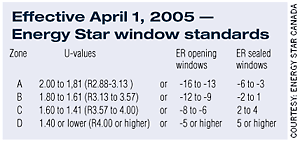
And this April, the standard
for Energy Star is ratcheted up. Figure 1 shows the new standards. Also, Energy
Star qualified window or sliding glass door must have at least an A2 for airtightness.
The windows must further be rated for their airtightness, watertightness,
and their capacity to withstand strong winds.
Why should contractors be interested in Energy Star windows? One reason is
the series of incentives being offered to homeowners to upgrade energy savings.
For example, Union Gas Limited, with Centennial Windows, is offering residential
customers in Southwestern Ontario a $50.00 rebate on every Energy Start qualified
window installed until May 31, 2005. The rebate will appear as a credit on
the Union Gas bill and there is no limit to the number of windows that can
be installed or the size of the rebate.
Installing
windows
Manufacturers of high-performance windows have long complained that the installation
process can detract from the window's overall performance. To that end, the
Siding and Window Dealers Association of Canada has developed an installation
training video. The "Sill to Sash" video deals with different frame
types, how windows are tested, what the test results mean and more importantly
how to get a professional installation. It is endorsed by the Window and Door
Manufacturers Association, SAWDAC, The Canadian Standards Association and
Natural Resources Canada. The video is available either in VHS format or as
a CD-ROM. For a copy, visit www.sawdac.com
and follow the prompts. HB