




Outlook
sees starts slowing through 2006
 |
OTTAWA - New home building
in Canada will slow in 2005 from the 17-year high of a year earlier, according
to Canada Mortgage and Housing Corporation.
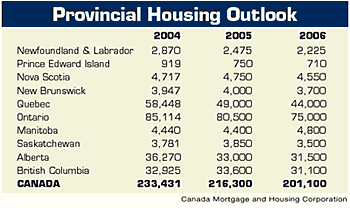
Total starts are now forecast to reach 216,300 units this year. Residential
construction will continue to ease in 2006 with housing starts dipping 7.0
per cent to 201,100 units.
"The housing market is set to slow in the months ahead as the demand
for home ownership begins to ease toward more sustainable levels," said
Bob Dugan, Chief Economist at CMHC. "Interest rates are forecast to nudge
higher in both 2005 and 2006 and house prices will continue to rise. As a
result, mortgage carrying costs will rise, which will temper demand for home
ownership."
As well, existing home sales are forecast to decrease 2.4 per cent to 445,100
units this year. The average resale price will increase by 5.8 per cent in
2005 and 3.4 per cent in 2006, however.
Housing starts in British Columbia are expected to rise modestly this year
to 33,600 units, up 2.1 per cent from 32,925 units in 2004. Growth will be
based on economic growth, momentum from past employment gains, and positive
migration flows.
Ontario home starts, at 85,114 units in 2004, ended the year just short of
a 15-year record. Construction will edge lower over the next couple of years
as mortgage rates inch up and the growing number of listings offer home buyers
more choice. Starts in 2005 will reach 80,500 units, their third highest level
in 15 years, and edge lower in 2006 to 75,000 units.
In 2004, housing starts in Quebec reached 58,448 units, but will fall 16.2
per cent in 2005 to reach 49,000 units and fall further to 44,000 units in
2006.
Investment in the energy sector and a large provincial budget surplus will
result in a strong Alberta economy in 2005 and 2006. Nevertheless, housing
starts will decrease to 33,000 units in 2005, down from 36,270 units in 2004.
Total housing starts in Saskatchewan will edge higher from 3,781 units in
2004 to 3,850 units this year and then slide to 3,500 units in 2006.
In Manitoba, housing starts will decline slightly from 4,440 units in 2004
to 4,400 units in 2005 and rise to 4,800 units in 2006. Higher population
growth is the major driver behind the strong outlook for residential construction.
After slowing to 3,947 units in 2004, new home construction in New Brunswick
is expected to remain level this year. Housing starts are expected to reach
4,000 and 3,700 units in 2005 and 2006, respectively.
Nova Scotia's housing market will remain below its recent peak in the residential
real estate cycle in both 2005 and 2006. However, economic conditions are
expected to be sufficiently healthy over the forecast period. Total housing
starts will edge higher from 4,717 units in 2004 to 4,750 units this year
and decrease to 4,550 in 2006.
Prince Edward Island's residential construction will remain strong but will
decline from 919 starts in 2004 to 750 starts in 2005 and 710 starts next
year.
In Newfoundland and Labrador, economic conditions will deteriorate compared
to recent years. When combined with rising inventories of existing homes,
residential construction will decline from 2,870 starts in 2004 to 2,475 and
2,225 starts in 2005 and 2006, respectively. HB