




The
new ICFs
By Dermot Mack
The new generation of popular insulated concrete forms are now coming on
stream
 |
Since their introduction
a decade ago, insulated concrete forms have proved popular with home builders
right across Canada, with particular take-up in Atlantic Canada and in the
EnerGuide homes being built in Ontario. It is yet to be seen what effect having
near-solid concrete walls will have on the future renovation/addition market
but, in the meantime, ICFs continue to evolve into a second-generation building
material.
Although various types of ICFs have been around for years, recent advances
and product developments are bringing in a new dimension, virtually eliminating
some of the drawbacks of earlier systems. Evaluation of several leading products
reveals fundamental variations of the ICF core structure.
Typical ICFs have inner concrete cores 4, 6, or 8 inches wide. When combined
with 2 to 2-1/2 inches or more of rigid foam insulation per side, the resulting
ICF wall thickness is in the 8- to 12-inch range. Finish materials such as
interior gypsum wallboard or exterior stucco or siding add another 1-1/2 inches
to the total wall thickness. Answering the demand for heavy retaining wall
applications, some manufacturers now offer systems with inner cores of 10,
12, 14 and even 16 inches or more. These super-thick walls provide exceptional
strength, energy efficiency and sound isolation. However, the added wall thickness
also subtracts from the total interior floor space which, in a small home,
could be significant.
Quad Lock, one of the ICF pioneers, has overcome one of the problems with
the insulated forms by introducing a new Fastening Strip (FS) panel. The three
panels now part of Quad-Lock's product line can be used to form six different
wall configurations, allowing flexibility that was lacking with most ICF products.
The fastening strips in the panel are held by the ties and thus provide for
an uninterrupted vertical attachment. The main purpose is to allow easy installation
of lapped siding. Production of the FS panel began last October 2004. The
six wall configurations range in R-value from R22 to R40. InHoff Systems of
Kelowna, B.C., is the Canadian distributor of the TF System, an insulated
form system that incorporates vertical trusses.
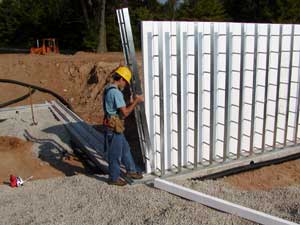
"You can build in one go, from the floor to ceiling," explained
Mathews Inhoff, marketing manager. The difference with the system, as compared
to block-based ICFs, is that heights in excess of 20 feet are possible in
one pour. The TF panels come in custom sizes or in standard heights of from
eight to 12 feet. The wall thickness can be as wide as two feet, Inhoff said.
It also has special window and door bucks with OSB sheathed foam panels.
Arxx Building Products, based in Cobourg, Ontario, has recently opened a new
41,000-square-foot manufacturing plant in Calgary known as Perfect Fit, an
indication of the national appeal of ICFs. Arxx insulated concrete forms are
stacked on site and fitted with rebar. Arxx's wall systems include a vapour
barrier and insulating layer in one, another improvement in the evolving ICF
market.HB